What Are Neuromorphic Chips? Computers Modeled on the Brain
AI is powerful. It's also shockingly power-hungry. A radical new kind of processor, one that mimics the brain's own wiring, could slash its energy use by a factor of 1,000.

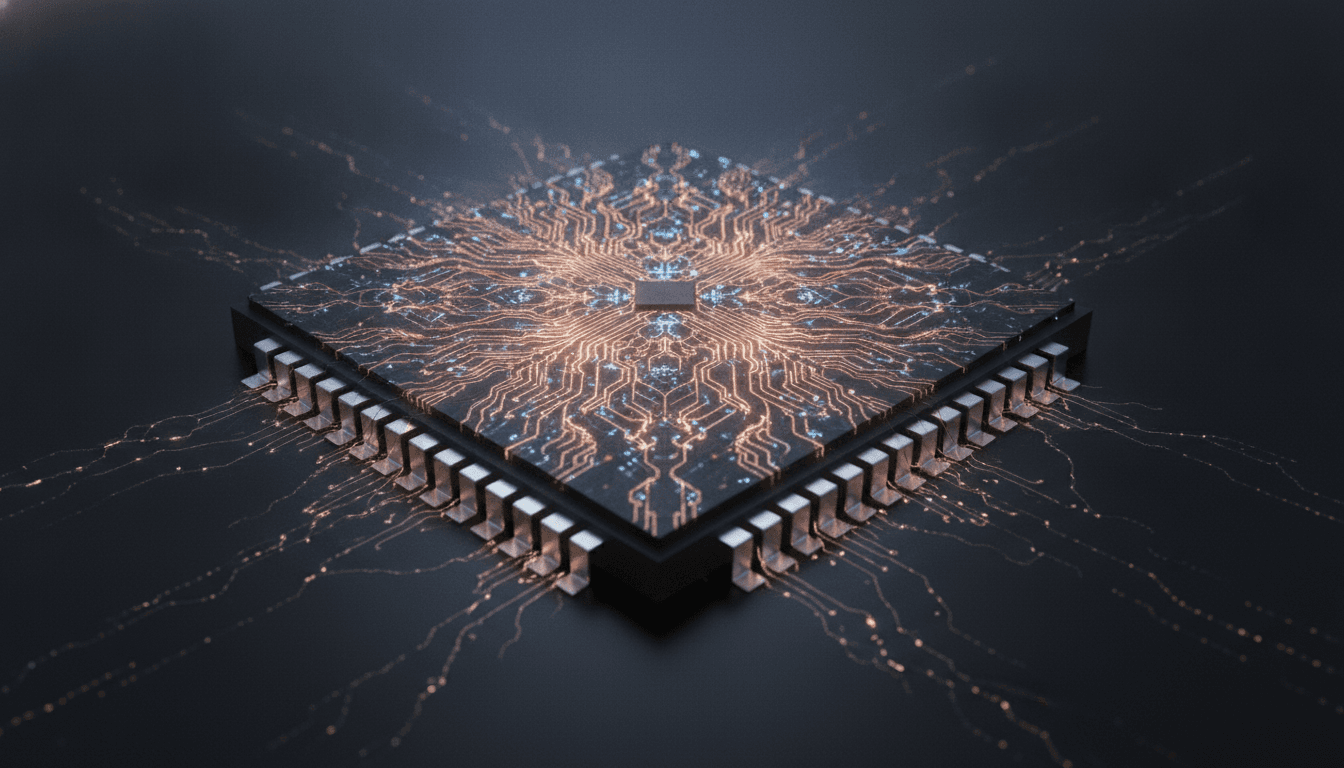
Artificial intelligence has a huge problem. Energy. Training and running today's massive AI models guzzles an astonishing amount of power, a challenge that's pushing researchers to find a smarter way forward. And some of the brightest minds in computing think the answer isn't just building more data centers. It's a total redesign of the computer chip itself—a chip modeled directly on the human brain.
Meet the neuromorphic chip. It's a special kind of hardware designed to process information in a way that’s totally alien to the computers we use every day. Instead of chewing through instructions one by one, these brain-inspired chips copy the very structure of our neurons and synapses, a strategy known as neuromorphic computing that promises to make AI vastly more efficient. This could unlock new frontiers in robotics, autonomous systems, and edge computing that are currently impossible because of raw power demands. After all, the human brain pulls off miracles of thought while sipping a mere 20 watts of power. That’s about what it takes to run a dim lightbulb.
The core idea isn't new. Caltech professor Carver Mead actually coined the term 'neuromorphic' back in the 1980s, arguing in a foundational 1990 paper that copying biological nervous systems into silicon was the path to massive efficiency gains. For decades, it was a concept that lived mostly in research labs. Not anymore. As the energy bill for AI becomes a critical bottleneck, Mead's vision is suddenly getting serious commercial attention.
Escaping the von Neumann Bottleneck
So what makes these chips so different? To get it, you first have to understand the half-century-old design principle they’re built to replace: the von Neumann architecture. Nearly every digital computer today, from your phone to a supercomputer, is based on it. This design draws a hard line between the central processing unit (CPU) and the memory, and information is constantly hauled back and forth between the two over a data bus.
That constant traffic creates a huge problem. The von Neumann bottleneck. Even as processors got exponentially faster, the connection to memory just couldn't keep up, wasting enormous amounts of time and energy simply moving data around before any real work gets done. It’s an 'intellectual bottleneck that has kept us tied to word-at-a-time thinking,' as the man who coined the term, computer scientist John Backus, put it.
Brain-like computer chips demolish this separation. In a neuromorphic design, memory and processing are woven together at a granular level—much like how synapses in the brain both store information (the strength of the connection) and help process it. This 'in-memory computing' approach radically cuts down on data movement. The result? Big gains in speed and power efficiency.
The Language of Spikes
The other big break from tradition is how these chips process information. Traditional AI models, like the deep learning networks behind image recognition and large language models, run on continuous numerical values, processed in a synchronized lockstep. Every single neuron in a layer calculates an output on every single cycle. It doesn't matter if the input is meaningful or just noise.
Neuromorphic systems work differently. They use Spiking Neural Networks (SNNs). In an SNN, the artificial neurons talk to each other using discrete, asynchronous pulses—'spikes'—just like the real thing. A neuron only fires off a spike when it gets enough input from its neighbors to cross an electrical threshold.
This 'event-driven' approach is incredibly efficient. Why? Because circuits stay quiet, using almost zero power, until a spike arrives that actually signifies something important. Information here isn't just encoded in the strength of a signal, but in the precise timing and pattern of the spikes themselves, which allows SNNs to process sparse, asynchronous real-world data with uncanny efficiency.
Where the Research Stands: From Lab to Real World
For a long time, neuromorphic hardware was the exclusive domain of academic and corporate research labs. But that's changing. The technology is hitting an inflection point, with big tech players and agile startups all showing off chips with serious power.
Intel has been a major force here with its Loihi family of research chips. Its latest, Loihi 2, came out in 2021. It packs a million artificial neurons onto a chip that can run on as little as one watt. Research has shown Loihi 2 can be nearly 30 times more energy-efficient than a typical GPU on certain sensor fusion tasks, and its technology now powers the world's largest neuromorphic machine—the Hala Point system at Sandia National Labs, which simulates a staggering 1.15 billion neurons.
IBM Research has been a pioneer too, from its TrueNorth chip back in 2014 to the more recent NorthPole prototype. NorthPole takes the brain-inspired idea of co-locating memory and compute to a whole new level. How does it perform? In tests on image recognition, it was 25 times more energy-efficient than a contemporary GPU. It even posted stunning results with large language models, hitting latency speeds 47 times faster than the most energy-efficient GPU it was tested against.
And it's not just the giants. A whole ecosystem of startups is now pushing neuromorphic tech into specific commercial applications:
- Innatera is producing ultra-low-power processors for 'always-on' sensor devices like smoke detectors and health monitors.
- BrainChip offers its Akida processor IP for edge AI devices, enabling on-device learning.
- Neurobus is developing neuromorphic solutions designed to handle the extreme conditions and power constraints of space applications.
Don't forget the big international efforts, either. The European Union's Human Brain Project, which wrapped up in 2023, was instrumental in producing advanced platforms like SpiNNaker and BrainScaleS. These systems gave neuroscientists and engineers the sandboxes they needed to test brain-inspired computing principles at a massive scale.
The Road Ahead for Brain-Inspired Chips
For all the promise, neuromorphic computing isn't about to kick GPUs out of the data center tomorrow. Big challenges remain. The software and algorithms needed to program these event-driven, asynchronous chips are a completely different beast than traditional code, creating a steep learning curve for developers. There’s no real standardization across different hardware platforms, and translating the brain’s complex, ever-changing learning rules into stable silicon is still a profound scientific puzzle.
But the motivation to solve these problems is stronger than ever. The insatiable power drain of conventional AI is creating a huge economic and environmental push for something better. By ditching a 70-year-old architectural blueprint and taking cues from the three-pound computer in our heads, neuromorphic hardware offers a compelling way forward. This isn't just about faster machines in the cloud; it's a path toward a new class of intelligent agents that can see, hear, and react to the world with the efficiency of a living thing. As Carver Mead puts it, 'You can't learn how a thing works unless you can build it and make it work. And that is a tall order.'”
For more on where AI is headed, see our article on The AI Predictions Experts Actually Agree On and for a deeper dive into how AI sees the world, explore What Is Computer Vision? Inside the AI That Teaches Machines to See.
To dive deeper into advanced computing, check out our explainer on What Is Quantum Supremacy, and Has It Actually Been Achieved? and how AI systems are built with What Is Deep Learning? And How Is It Different From Machine Learning?.
Related Articles



This article was produced with AI assistance under human direction, and reviewed and fact-checked by a named editor before publication. How we work.
Frequently asked questions
- What is the main advantage of neuromorphic chips?
- The primary advantage of neuromorphic chips is their incredible energy efficiency. By mimicking the brain's structure and using event-driven 'spikes' for communication, they only consume power when actively computing. This can make them hundreds or even thousands of times more efficient than traditional GPUs for certain AI tasks, which is critical for battery-powered devices and reducing the energy footprint of large-scale AI.
- How do neuromorphic chips work differently from CPUs/GPUs?
- Unlike CPUs and GPUs, which shuttle data back and forth between separate processing and memory units (the von Neumann architecture), neuromorphic chips integrate memory and computation. They use Spiking Neural Networks (SNNs), where artificial neurons only fire when an input threshold is met. This 'event-driven' and parallel architecture is fundamentally different from the continuous, clock-based processing of conventional chips, making them better suited for processing sparse, real-world sensory data.
- Are neuromorphic chips available today?
- Neuromorphic chips are transitioning from pure research to commercial application. While you can't buy one for your desktop computer, companies like Intel (Loihi 2) and IBM (NorthPole) have advanced research chips used by scientists globally. Additionally, startups like BrainChip and Innatera are now shipping commercial neuromorphic processors for specific edge AI applications in robotics, sensors, and autonomous systems.
- What are the main challenges for neuromorphic computing?
- The biggest hurdles for widespread adoption of neuromorphic computing are software and complexity. Programming these brain-like computer chips requires a completely different approach than traditional coding. Developing the right algorithms and creating standardized software tools that work across different neuromorphic hardware is a major focus of current research. Translating the complex learning mechanisms of biological brains into stable silicon is also an ongoing challenge.
- How are neuromorphic chips related to Spiking Neural Networks (SNNs)?
- Spiking Neural Networks are the software and architectural model that neuromorphic chips are built to run. SNNs are a type of neural network where information is encoded in the timing of discrete electrical pulses, or 'spikes,' similar to biological neurons. Neuromorphic hardware is the physical silicon designed specifically to execute these spike-based computations in an extremely energy-efficient, asynchronous, and parallel manner, which is difficult for traditional chips to do.
Sources & further reading
Sources
- humanbrainproject.eu — humanbrainproject.eu
- devthrottle.com — devthrottle.com
- ajithp.com — ajithp.com
- medium.com — medium.com
- techtarget.com — techtarget.com
- wikipedia.org — en.wikipedia.org